Spielautomaten





Pinball Peak transforms a pinball table into an instant casino game: a ball descends between bumpers, a mill, a respin hole and a central rune, while each contact adds its value to the payout. Launched on June 26, 2025 by Paperclip Gaming, this Stake-exclusive title is powered by Stake Engine and deliberately moves away from traditional reel slots.
The official specifications announce an RTP of 96.00%, a betting range between 0.10 and 1,000 units per round and a maximum win of 103.90× the bet. The volatility is not published: neither the relatively short cap nor the fast pace of the rounds allow for a reliable rating.
An arcade game with no reels or paylines
Pinball Peak uses no grid, no Wild symbols and no combinations on paylines. A press of the button launches a ball from the top of the screen. It then bounces off the obstacles without the player being able to adjust its trajectory, and then either leaves the board or finds the hole that triggers a new ball. Several balls can circulate at the same time if the rounds are launched in quick succession.
This format makes each result easy to follow: the amount added appears at the point of impact and the total increases right before the player's eyes. However, this visual clarity should not be confused with any kind of skill-based control. Launching does not turn Pinball Peak into a game of precision; the result remains determined by the random operation of the game.
How targets build the payout
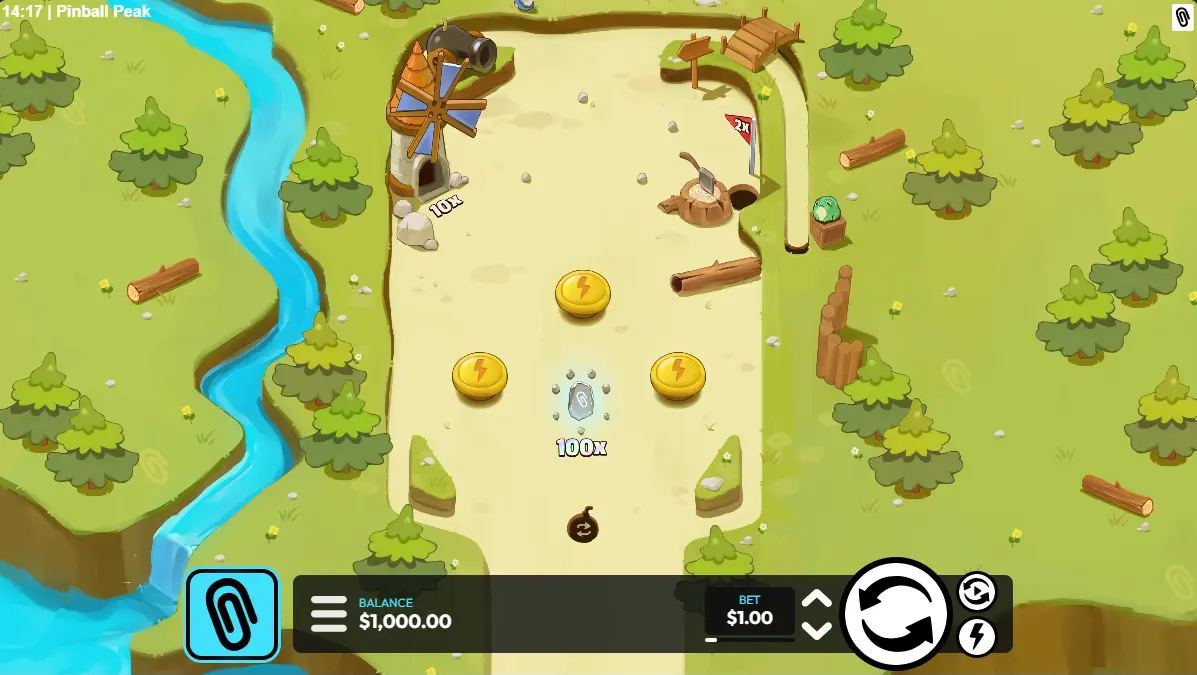
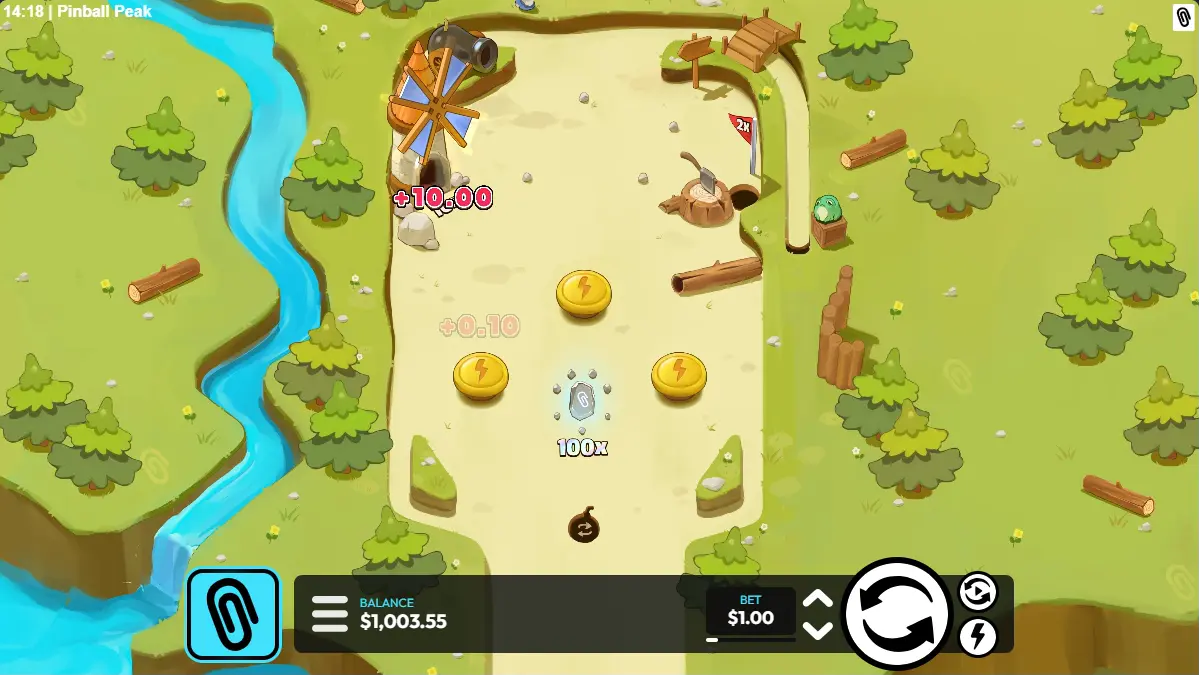
For a baseline bet of 1.00, the Lightning Bumper is worth 0.10×, the hole is 2×, the mill is 10× and the rune is 100×. A ball can hit several elements during its fall, meaning the final payout corresponds to the visible accumulation of impacts rather than a single combination.
The hole located on the right side plays a special role. When the ball enters it, it pays out its value and then automatically triggers a respin, meaning a new trajectory without requiring a second standard bet. The cannon, the 2× flag, the logs and the walls also add rhythm to the bounces, but the official paytable does not award an individual payout to all of them.
Criterion | Value |
|---|---|
Developer | Paperclip Gaming |
Distribution | Stake Exclusive, Stake Engine technology |
Release date | 26 June 2025 |
Type | Arcade / Burst game, no reels or lines |
Theoretical RTP | 96.00% |
Volatility | Not published |
Displayed bet | 0.10 to 1,000 units per round |
Maximum win | 103.90× the bet |
Main targets | Bumper 0.10×; hole 2×; mill 10×; rune 100× |
Options | Cannon Ball 2.50×; Super Ball 5.00× |
The cap of 103.90× comes from the maximum expected accumulation for a round, and not from a rare symbol landing on a line. This difference is important when reading the game: small contacts can add up, but the 100× rune alone holds the bulk of the fixed potential. The result remains capped, even when a respin extends the sequence.
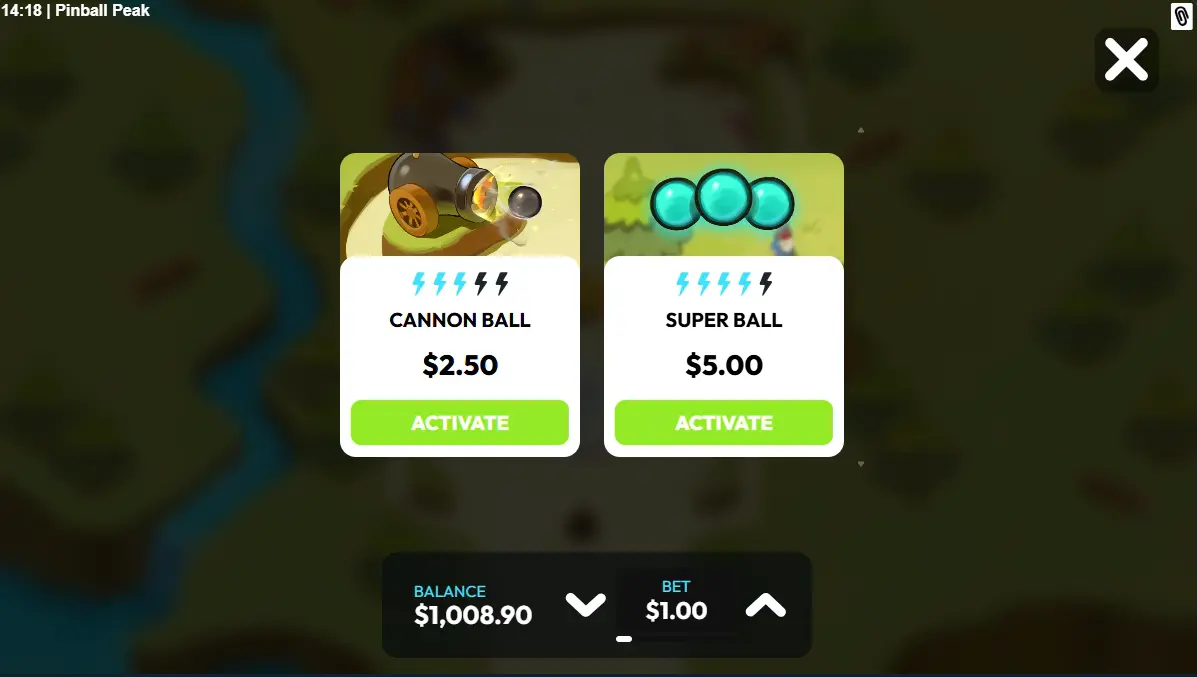
Cannon Ball and Super Ball: two paid options
The Paperclip button opens up two round variations. Cannon Ball costs 2.50× the selected bet and guarantees that the ball goes through the cannon before heading back onto the board. This route therefore forces the respin linked to the device, but it does not determine either the subsequent bounces or the final multiplier.
The Super Ball option costs 5× the bet. It releases balls announced as being more likely to bounce and produce a higher payout. The price is debited to modify the round, not to buy a guaranteed amount. For an identical displayed bet, the actual exposure is therefore multiplied by 2.5 or 5 even before the ball drops.
RTP, betting range and missing information
The theoretical RTP of 96.00% corresponds to a mathematical house edge of 4.00% over a very large volume of rounds. It does not mean that a session will return 96% of the bets, and it does not reduce the possible variance between two successive trajectories. No alternative RTP profiles are documented on the official sheet consulted.
The range of 0.10 to 1,000 units is displayed without a universal currency and may depend on the market or the operator. Volatility and hit frequency are not published. It is therefore best to stick to the amounts actually shown in the interface and not deduce a risk profile solely from the animation of the board.
A natural-themed board that remains readable despite the bounces
The setting combines a turquoise river, pine trees, logs and a mill around a sand-coloured track. A small frog watches the game from the right edge. The important targets use very different shapes and values, making it quick to understand whether the ball has hit a bumper, the hole, the mill or the 100× rune, even when multiple trajectories overlap.
The same studio also offers Scroll Keeper, a more conventional slot. The comparison highlights the originality of Pinball Peak: here, the entire round takes place on the vertical board, with no reel phase before or after the ball drops.
Which player profile is Pinball Peak aimed at?
Pinball Peak is best suited to players who prefer short rounds, a visible impact-by-impact result and a clearly announced cap. Fans of cascades or free spins will not find those mechanics here. For a ball drop integrated into a real 5×3 grid, Pine Of Plinko 2 offers a very different structure with reels, scatters and a dedicated bonus.
The strength of Pinball Peak lies in its single rule: launch a ball, follow its contacts and watch the payout evolve without any intermediate screens. The hole's respin and the Cannon Ball or Super Ball options enrich the loop without overcomplicating it. Its RTP and cap are documented; its volatility is not, a point to keep in mind when evaluating the game based on facts rather than its apparent simplicity.